
The main differences in the level of protection offered by UPS power supplies result from their design and the way they transfer energy to connected devices. Below is a detailed overview of the available technologies:
1. Offline (Standby) Power Supplies
This is the simplest and cheapest type of power supply, offering a basic level of protection.
• Mechanism of operation: Under normal conditions, electricity flows directly from the mains to the devices, and the inverter and rectifier are only activated when the voltage drops.
• Protection: The device remains in standby mode until a failure is detected. Switching to battery power takes a few milliseconds, which can cause short power interruptions.
• Application: Recommended for less demanding users, e.g., to protect routers, but not recommended for expensive electronics.
2. Line Interactive Power Supplies
They offer a medium level of protection, which is an optimal compromise between price and quality for home use.
• Mechanism of operation: Similar to offline models, they switch to battery power in the event of a failure, but additionally have a built-in automatic voltage regulator (AVR).
• Protection: They stabilize the voltage during normal operation, compensating for fluctuations without having to switch to battery power. This protects equipment from minor voltage spikes and extends battery life.
• Application: Home computers, televisions, alarm systems.
3. Online (Double Conversion) Power Supplies
They provide the highest and most reliable level of protection.
• Mechanism of operation: They use the double conversion method – alternating current from the mains is converted to direct current and then back to alternating current with stable parameters.
• Protection: The devices are completely isolated from the electrical network, which completely eliminates interference and ensures maximum voltage stability. There is no switching time (0 ms), which guarantees the highest quality of power supply without interruptions.
• Application: Server rooms, laboratories, hospitals, advanced audiophile systems, and home servers.
4. ECO and Active ECO modes
Advanced systems use specific operating modes that change protection priorities in favor of energy savings:
• ECO mode: Offers high efficiency (up to 99%), but does not provide the same level of protection as online mode. The load is supplied with “raw” energy from the mains via a bypass line, and the UPS must respond to a problem (which takes 1 to 16 ms) before switching to the inverter.
• Active ECO mode: This is the “golden mean” – the inverter runs in parallel with the mains at all times. This makes power transfer faster than in standard ECO mode, and the power supply provides power filtering and harmonic absorption similar to online models.
Summary of differences:
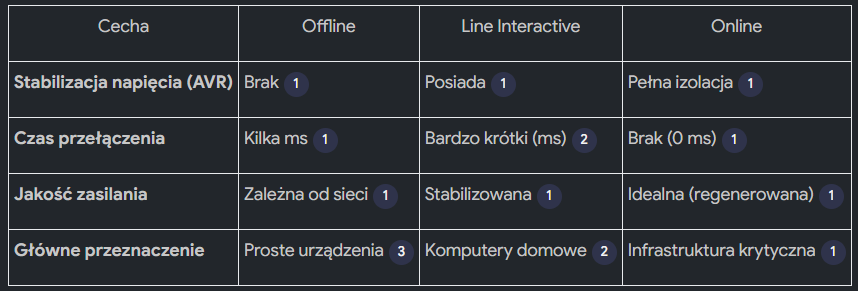
To understand this better, imagine different ways of filtering water. An offline power supply is like a vessel into which you pour clean water from a spare container only when the tap runs out of water. Line Interactive is a tap with a built-in strainer that filters out larger impurities on an ongoing basis. An online power supply, on the other hand, works like an advanced treatment plant that draws water from any source, purifies it completely, and delivers a product with ideal parameters, regardless of what is happening in the water supply.